

Table of Contents
ToggleAnthropic AI Valuation and IT Stock Sell-off
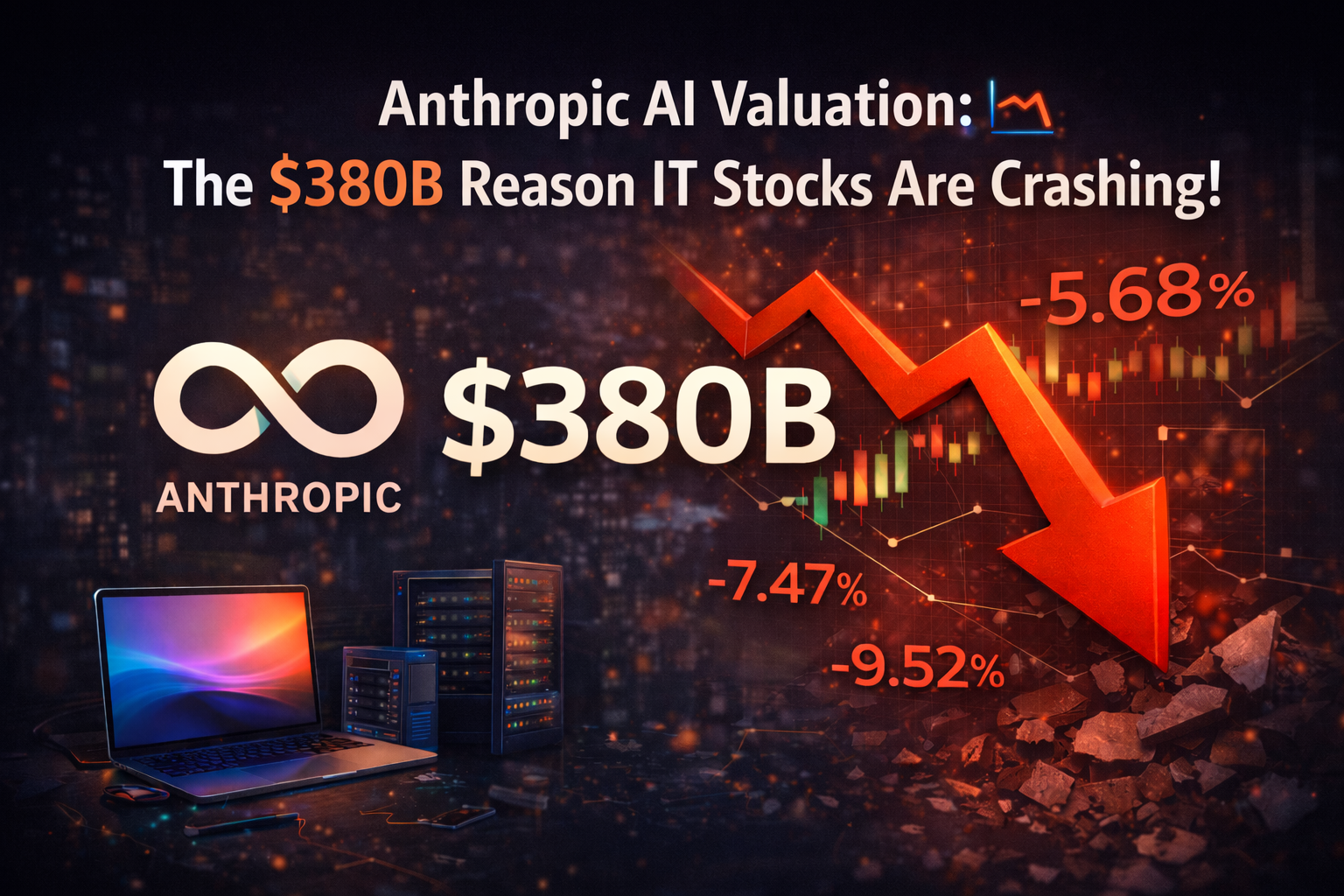
Anthropic AI Valuation has reached a staggering $380 billion following a record-breaking $30 billion Series G funding round. As of early February 2026, this massive infusion of capital—led by GIC and Coatue with participation from Nvidia and Microsoft—has not only solidified Anthropic’s position as a premier AI powerhouse but has simultaneously sent shockwaves through the global equity markets. The sheer scale of this valuation shift has redirected investor focus away from traditional Software-as-a-Service (SaaS) and toward the era of Autonomous Agentic AI.
While the valuation surge is a victory for AI enthusiasts, it has triggered a broad-based "Software-mageddon" across the US and Indian IT sectors. The catalyst for this market correction was the unveiling of Anthropic’s latest enterprise tools, Claude Code and Claude Cowork, which promise to automate end-to-end software delivery cycles that previously required thousands of human billable hours.
In this 1,200+ word technical analysis, we explore the structural valuation flip occurring in Mumbai and New York, deciphering why a single AI tool release wiped out nearly $280 billion in market capitalization from the IT services industry in a single trading session. Is this a temporary tactical correction, or are we witnessing the permanent cannibalization of the traditional software business model?
📊 Anthropic Series G & Market Impact Matrix
| Key Metric | 2025 Benchmarks | Feb 2026 Shift |
|---|---|---|
| Post-Money Valuation | $183 Billion | $380 Billion |
| Annualized Revenue | $1.4 Billion | $14 Billion (10x Increase) |
| IT Service ADR Index | Sustained Growth | -12.4% (Single Day) |
📉 The "Anthropic Effect": Global Market Sell-Off
The "Anthropic Effect" has created a stark divergence in the tech ecosystem. While Anthropic AI Valuation has ascended to unicorn-of-unicorns status, the traditional software service providers—including major Indian players like Infosys and Wipro—are facing a valuation rerating. Investors are pricing in the risk that AI agents will replace "human-in-the-middle" workflows, fundamentally threatening the headcount-based billing models of the IT services industry.
As shown in the data above, the unveiling of Claude Cowork coincided with a sharp 8.32% drop in Infosys ADR and nearly a 10% plunge for Intuit. The market's logic is simple: if an AI tool can write, test, and deploy production-grade code autonomously for $50 a month, the pricing power of a $100/hour offshore developer is effectively capped. This is the new defensive reality for software portfolios, where "AI-native" capability is the only hedge against total obsolescence.
🏗️ The Infrastructure of Disruption: Claude Cowork
What makes the Anthropic AI Valuation of $380 billion justifiable in a cooling tech market? The answer lies in the pivot from "Chatbot" to "Coworker." Anthropic’s newest releases—Claude Code and Claude Cowork—are no longer just predicting the next token in a sentence; they are performing high-fidelity, production-grade engineering tasks. Claude Code, which already generates $2.5 billion in annualized revenue, is capable of scanning entire repositories, identifying compliance risks, and writing self-healing scripts that maintain production environments without human intervention.
This move into "Agentic AI" is the primary reason for the software sector's valuation reset. Unlike previous AI cycles that improved human productivity, Claude Cowork is designed as a direct substitute for entry-to-mid-level software service blocks. When an AI agent can coordinate multi-step workflows across Jira, GitHub, and AWS autonomously, the traditional "SaaS" model—where companies pay per seat for a tool that humans use—begins to look obsolete.
💎 Technical Pillars of the "Anthropic Effect"
- Infinite Scalability: Unlike IT service delivery teams that require months to scale, Claude Cowork can instantiate 10,000 "virtual developers" in milliseconds to handle a project spike.
- Autonomous Compliance: Integrated audit blocks ensure all AI-generated code meets global SOC2 and ISO standards, a task that typically consumes 15% of an IT service firm's delivery time.
- Revenue Velocity: With a 10x year-on-year revenue increase to $14 billion, Anthropic is demonstrating the fastest capital-efficiency ratio in silicon history.
For the software and IT services industry, this represents a structural pivot. The market is shifting from "Headcount-Based Valuation" to "Outcome-Based Valuation," where the winner is the entity that owns the most intelligent model, not the one that employs the most developers.
📉 Value Projections: US Software vs Indian IT Stocks
The 2026 market correction isn't just about valuation; it's about the Pricing Pressure being exerted on the world's largest service providers. As Forbes reports, the Emergence of the AI-Native Corporation is forcing a massive sector rotation. Long-standing software giants like Adobe and Salesforce are seeing "cannibalization risk" as their core features are replicated and automated by Anthropic’s open-architecture models.
📊 Comparative Pricing Erosion Index
| Sector | Pre-AI Multiples | Feb 2026 Reset |
|---|---|---|
| US Enterprise SaaS | 14x EV/Rev | 9.5x EV/Rev |
| Indian IT Services | 24x P/E | 18.5x P/E |
| AI Infrastructure (Anthropic) | 130x Growth | Total Market Premium |
This valuation reset is particularly painful for the Nifty IT index in India, which has historically enjoyed a "defensive" premium. With utilization rates expected to drop as Claude Code takes over maintenance contracts, Indian giants are now pivoting to "AI Consultancy" to protect their margins from the impending collapse of legacy outsourcing models.
📉 "SaaSpocalypse": The Strategic Technical Correction
The term "SaaSpocalypse" is no longer just hyperbole among tech traders. The $1 trillion wiped off global tech cap in early February 2026 is a definitive Tactical Correction. Investors are finally acknowledging that the current software landscape is over-saturated with tools that solve problems which can now be handled by a single unified Agentic AI model like Claude. This has resulted in two main shifts that are redefining the software and IT stocks category:
REVENUE CANNIBALIZATION
Companies are cancelling $100k/year specialized SaaS subscriptions for tools like Salesforce or Intuit, replacing them with custom AI agents powered by Anthropic's API that perform the same tasks for a fraction of the cost.
THE "BENCH" CRISIS
In the Indian IT services sector, the "bench" (unallocated developers) is growing at its fastest rate in history. Claude Code's ability to automate maintenance means the demand for large delivery teams is shrinking, causing a fundamental valuation rerating for IT stocks.
This is isn’t just a market dip—it’s a purge. The capital is rotating out of companies that "house" data and into companies that "process" intelligence. As Anthropic valuation climbs to $380 billion, the "SaaSpocalypse" ensures that only the most AI-integrated legacy firms will survive the next 24 months of technical Darwinism.
🚀 The Professional Verdict: Fighting the "Anthropic Effect"
The transition to the Anthropic AI Valuation era marks the end of the "Software as a Dashboard" phase. For tech professionals and investors, the strategy must now focus on the AI-Native Layer. While the sell-off in IT stocks has been brutal, it has opened a window of opportunity for "defensive" entries into legacy software companies that possess deep data moats and the capital to integrate Anthropic’s LLM stack directly into their core offerings.
The Strategic Takeaway: If you are invested in "workflow-only" SaaS or headcount-heavy IT services, the risk of obsolescence is at an all-time high. The move to the MacBook Pro M5 for local AI processing power, combined with Anthropic's enterprise agentic stack, means the future of production is decentralized. The new defensive staple is companies that own the "Intelligence Layer," not just the "Interface Layer."
Stay ahead of the "software-mageddon" by following our deep-dives into AI-first workstations and market valuation rotations at tech.sumitrana.com. The $380 billion valuation of Anthropic is just the start of a total market structural realignment.
❓ Anthropic AI Valuation & IT Stocks: FAQ
1. Why did Anthropic's valuation jump to $380 Billion? +
The valuation surge is driven by Anthropic's 10x revenue growth to $14 billion annualized and the rapid market adoption of Claude Code. Investors see Anthropic as the "Operating System of AI Engineering," justifying a massive premium over traditional software firms.
2. How does Claude Cowork differ from standard AI tools? +
Unlike standard AI that "suggests" code, Claude Cowork is "Agentic." It can autonomously navigate complex software repositories, communicate across Slack, and execute deployments with minimal human oversight, making it a direct competitor to IT delivery teams.
3. Will Indian IT stocks recover from this sell-off? +
Recovery will depend on how quickly firms like Infosys and TCS pivot from headcount-based billing to outcome-based AI services. The market is currently in a "show me" phase, waiting for these giants to demonstrate high-margin AI integration rather than just defensive maintenance.
4. What software sectors are most at risk of "SaaSpocalypse"? +
Enterprise sectors focused on compliance, documentation, basic analytics, and legacy software maintenance are most vulnerable. Specialized platforms like Intuit and standard CRM systems are facing intense "pricing pressure" as AI agents replicate their core utility at near-zero cost.
5. How should investors handle the IT stock crash? +
Investors should look for companies with "Data Gravity"—those that own unique, non-public data that AI models like Claude need to function. The shift is moving from "General Software" to "Domain-Specific Intelligence Layer," which will be the next frontier of market growth.
⚠️ Disclaimer: All financial and technical analysis regarding Anthropic AI valuation and IT stocks is based on current market trends and technical releases as of February 2026. This is not financial advice. Professional investment consultation is recommended given the high volatility of the tech sector.